
A Quiet Corner of Westlake
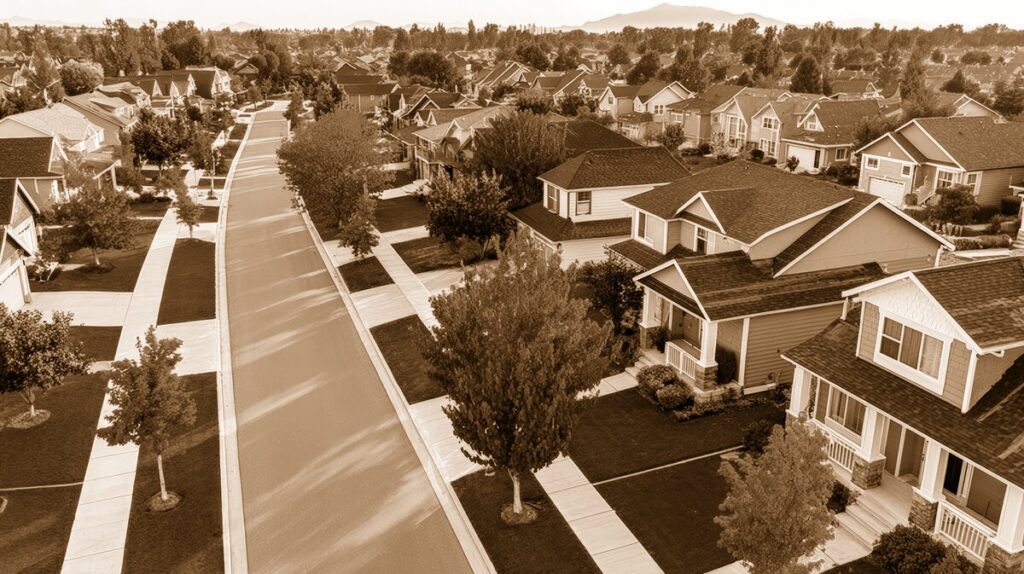
Tucked just west of Bradley Road, about a half-mile south of Detroit Road, Breckenridge Estates is one of those Westlake neighborhoods that feels established without feeling old-fashioned. Its tree-lined streets, generous lots, brick-front homes, and gently secluded setting create the impression of a community that has always belonged there.
In reality, Breckenridge Estates is a comparatively young neighborhood. Most of its homes were built between 1988 and 1991, during a period when Westlake was transforming from a primarily agricultural community into a mature suburban city. Today, the subdivision includes Breckenridge Trail, Wilderness Trail, and a portion of Silveridge Trail. The community contains approximately 26 single-family homes, many set on spacious lots with mature landscaping.
What makes Breckenridge Estates special is the way it reflects both sides of Westlake’s identity: the polished, convenient suburb residents know today and the open countryside that defined the area for much of its history.
From Dover Township to Westlake
Long before Breckenridge Trail appeared on a city map, the land around western Westlake was part of the Connecticut Western Reserve. The first families began establishing homesteads in the area in 1810 and 1811. Among the early settlers were the Cahoon, Porter, Johnson, Crocker, Clemens, Sperry, and Hurst families—names that remain familiar throughout Westlake’s history and, in some cases, on local streets and institutions.
The original community was known as Dover Township. Dense forests were gradually cleared for farms, pastures, orchards, and small industries. Waterways powered sawmills and gristmills, while the area around present-day Dover Center and Center Ridge roads became an important center of activity.
Agriculture remained central well into the twentieth century. Westlake was especially known for grain, small fruit, and grape production. The arrival of the Nickel Plate Railroad in 1881 helped connect local farms with larger markets, and by the late nineteenth century Dover Township had become one of the nation’s important grape-shipping centers.
The community’s name changed as its character and population changed. Dover Village was incorporated in 1911, then renamed Westlake in 1940 to avoid confusion with another Dover in Ohio. Westlake became a city in 1957, as postwar growth brought new neighborhoods, schools, roads, and businesses.
Breckenridge Estates belongs to that later chapter: the era when former farm fields and large tracts of open land were carefully planned into residential neighborhoods.
How Breckenridge Estates Got Its Name
The public record provides a useful glimpse into the subdivision’s beginnings. In 1986, Westlake records referred to John Chandler as the owner of the preliminary plan for Breckenridge Estates. The city later accepted a water-main easement from Breckenridge Properties Co. in 1987, confirming that the neighborhood was moving from planning into infrastructure and construction.
The exact inspiration for the name “Breckenridge” is not clearly documented in the historical sources available today. It appears to have been associated with the development company, Breckenridge Properties Co., rather than with a historic Westlake family or a specific local landmark. That is a common pattern in suburban development: a distinctive name helps establish an identity for a new community while suggesting permanence, refinement, and connection to the landscape.
Whatever the original marketing intention, the name has aged well. “Breckenridge” suits the neighborhood’s broad lots, wooded edges, and traditional architecture, giving the subdivision a character that feels more like a small residential estate than a typical postwar tract.
Streets with a Distinctive Character
The neighborhood’s layout is part of its appeal. Breckenridge Trail serves as the principal entrance, marked by a brick sign wall and a small matching gazebo-like feature. It is a modest landmark, but one residents and visitors recognize immediately.
Wilderness Trail curves through the interior of the subdivision and ends in a landscaped cul-de-sac. Silveridge Trail connects the neighborhood’s homes to the south and north, while Marshfield Boulevard borders the development to the west. The streets are private-feeling in atmosphere even though they are part of the larger Westlake street network.
Several features help preserve the neighborhood’s sense of space:
- Generous lots, many measuring roughly one-third to one-half acre.
- Mature trees and wooded rear yards.
- A small city-owned conservation parcel near the northwest end of Wilderness Trail.
- Landscaped entrances and quiet cul-de-sac design.
- Traditional brick-front homes with attached three-car garages and substantial interior living spaces.
These details distinguish Breckenridge Estates from denser subdivisions developed during the same period. The neighborhood was designed for privacy and comfort, while still placing residents close to Bradley Road, Detroit Road, Interstate 90, schools, shopping, and parks.
Milestones in the Neighborhood’s Story
The development of Breckenridge Estates followed the practical rhythm of suburban growth:
- 1986: Westlake reviewed a preliminary plan for Breckenridge Estates.
- 1987: The city accepted a water-main easement connected with the subdivision.
- 1988–1991: Most homes were constructed, creating the neighborhood’s core architectural identity.
- 2013: Westlake included Breckenridge Estates in a pavement rehabilitation program involving concrete repairs and asphalt overlay.
- 2020s: City infrastructure planning continued to address pavement, drainage, and stormwater needs in the surrounding residential area.
These milestones may sound ordinary, but they tell an important story. Neighborhood history is not only about grand buildings or famous residents. It is also about streets being accepted, water lines installed, pavement renewed, and successive generations of families making a place their own.
Nearby Landmarks and Institutions
Breckenridge Estates does not contain a historic public building in the traditional sense. Its heritage is found more in its setting and relationship to Westlake’s institutions.
Nearby Bradley Road connects the neighborhood to Detroit Road and the broader western side of the city. Residents are also close to Westlake’s parks, golf courses, recreation facilities, schools, and library services. Porter Public Library, one of the city’s best-known civic institutions, reflects the same community-minded tradition that shaped Westlake’s earlier settlement patterns.
The neighborhood’s western setting also preserves a visual link to the area’s rural past. Open land, wooded parcels, neighboring subdivisions, and nearby recreational landscapes offer reminders of the farms and country estates that once occupied much of Westlake. Even as Crocker Park and newer commercial areas have expanded the city’s modern identity, Breckenridge Estates remains noticeably residential and tucked away.
A Heritage That Continues
Today, Breckenridge Estates is best understood as a product of Westlake’s suburban maturity. It was created after the city’s major postwar population boom, but before every remaining open parcel was developed. Its homes are large and carefully detailed, yet the neighborhood’s strongest quality may be its sense of calm.
For longtime residents, the charm lies in familiar walks along Breckenridge Trail, the changing colors around Wilderness Trail, and the quiet transitions between established yards and wooded edges. For newer residents, the neighborhood offers a welcoming piece of Westlake history—one shaped by the city’s agricultural beginnings, its mid-century growth, and its continuing investment in livable communities.
Breckenridge Estates may not appear in every history book about Westlake, but it tells an important local story. It shows how former countryside became neighborhood, how thoughtful planning can create lasting character, and how a community built in the late twentieth century can already feel like home.